
Sarah Mostowich on what engineering really becomes when you follow the problems that matter

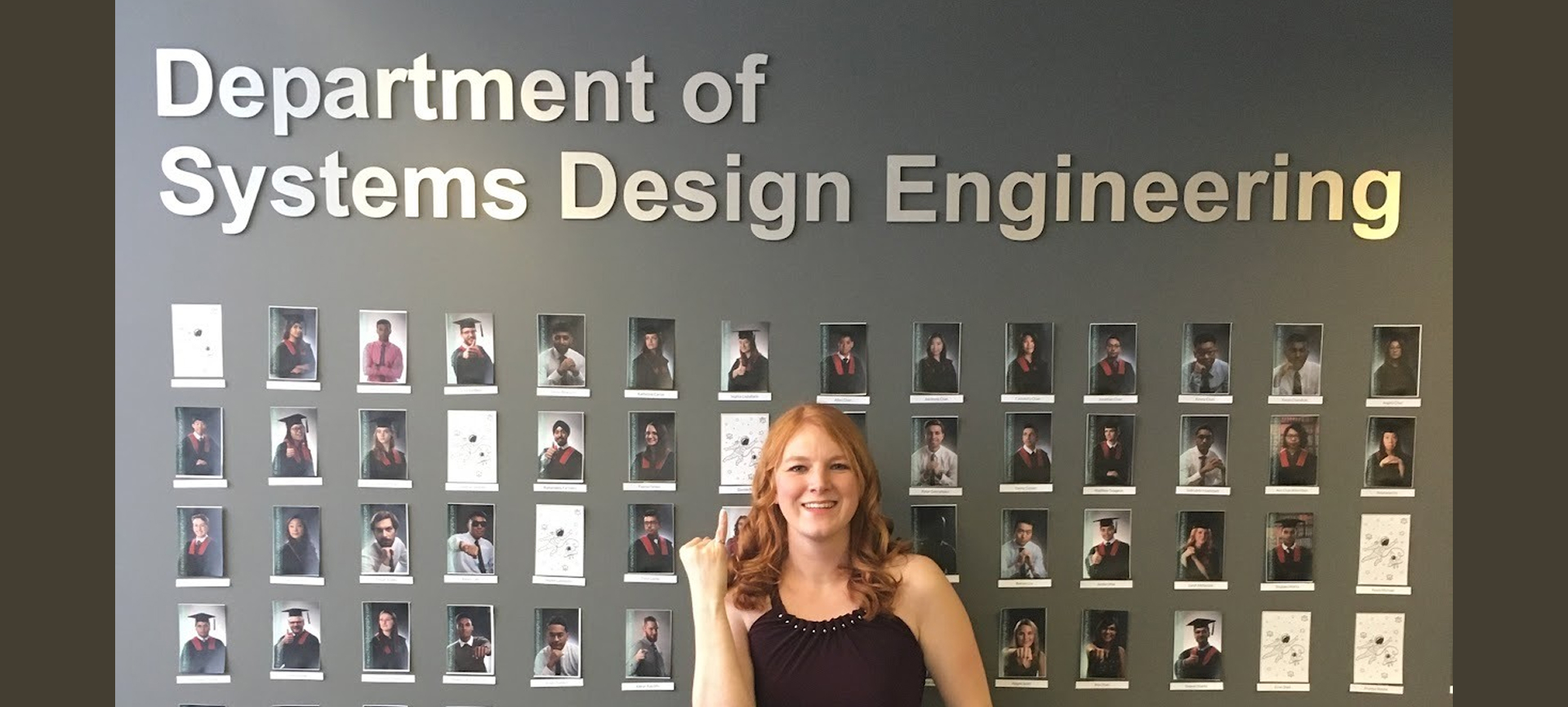
On International Women in Engineering Day, NorthGuide co-founder and Waterloo Systems Design Engineering grad Sarah Mostowich shares her thoughts on engineering as a way of thinking, building, and belonging.
Every year on June 23rd, International Women in Engineering Day (INWED) places a spotlight on the women who are shaping the field. Their work shines not just in labs and on job sites, but in boardrooms, governments, and communities around the world. The 2026 theme, Engineering Intelligence, feels especially fitting for someone like Sarah Mostowich, whose career is built on using systems thinking to solve complex, human-centred problems across sectors and continents.
Sarah is a University of Waterloo Systems Design Engineering graduate and co-founder of NorthGuide. Her leadership as Chief Strategy Officer helps clients around the world create tangible systems-level economic and human impact. We sat down with Sarah to talk about her path into engineering, what engineering means to her, and what she'd want every engineering student to know.
How did you choose Engineering? Was it the obvious path for you?
It felt like a logical one. I was always curious about why things worked the way they did — and, maybe more importantly, how they could work differently or better. I also liked that engineering had a reputation for being hard. I've always been drawn to hard things. If people said a program was difficult to get into and difficult to complete, that made me more interested, not less.
The other thread was that I've always wanted to make the world a better place. When I was in grade five or six, my class watched An Inconvenient Truth, and it really grabbed me. I became passionate about climate change and environmental conservation. I ran our school's Environmental Council in high school. When I first joined there were maybe ten people, mostly teachers, and when I graduated we had over fifty student members. That sense of rallying people around a shared cause was challenging and intoxicating, and it has stuck with me.
How did you end up going to Waterloo for Engineering — and did you find your people there?
I almost didn't go to University of Waterloo at all, mostly because both my parents went there and kept telling me it was the best school, which made me want to go anywhere else. Then I did an engineering shadow day. A second-year student took me to all her classes, we hung out in the engineering lounge, and by the end of the day I was a little annoyed at how much I loved it. Why are parents always right?!
What really hooked me were the people. Everyone I met was curious and a little nerdy and completely unashamed about it. They owned it in a way that made it feel cool rather than something to apologize for. I'd spent a fair amount of high school feeling a bit out of place for caring too much about ideas and wanting to do hard things, and then I walked into the engineering lounge at Waterloo and realized there was an entire community of people who were exactly the same way. We were nerds who wanted to build and figure things out and have a good time doing it. That domain, it turns out, wasn’t mine alone.
I remember being in an elevator in first year when three or four of us spontaneously started rattling off the same obscure Harry Potter reference at the same time. Normally that would be the kind of thing only I would know in my friend group. That was the moment I thought, okay, I found my people. That sense of belonging to a community of people who are genuinely curious and genuinely invested in solving seemingly unsolvable problems has shaped everything I've built since. NorthGuide runs on it.
(Side note, I also found my person, my now-husband Nick, through Waterloo Engineering.)
Your career has ended up at the intersection of engineering, international development, and systems change. Was that intentional?
I don't think I could have drawn a map to where I am. What I can tell you is the themes that keep recurring, because I navigate by impact and values rather than a destination.Systems change and integrated thinking are constant. So is the engineering instinct, especially its applied, pragmatic side.
The international development piece grew out of impatience, in the best sense. Toward the end of high school I started getting disenchanted with environmental work because the time horizon to see results is so long. You might wait decades to know if it worked. I wanted to test, iterate, and see what changed for people quickly. Improving someone's life gives you that immediate signal, and then you get the cascade effects: a healthier, more capable person goes on to create change themselves. I'm a believer in that butterfly effect.
International development offered that. The challenges are often mission-critical — things like access to clean water, health infrastructure, economic opportunity — and there's often genuine green-field potential because you're not working around decades of existing systems.
Systems Design Engineering isn't the most obvious credential for the kind of work you do in ecosystem strategy. How does it actually show up?
More than people would expect.
I was drawn to Systems Design precisely because it wasn't only about how a single component works. The technical "how" is interesting to me, but I care more about how the pieces work in concert as an effective system. That's always been my lens. And the "design" half matters just as much: it's not systems thinking for its own sake, it's designing elegant solutions that actually fit into the real world and get adopted. A solution that's brilliant on paper but never survives contact with real conditions isn't a solution.
That mindset is exactly what I bring to clients. When I'm working with an organization on a complex challenge — whether that's an innovation ecosystem strategy, a government policy problem, or helping a team of health-tech entrepreneurs in Barbados — the first question is never "what's the solution?" It's "what's the system?" Who are the players? What are the feedback loops? Where are things getting stuck, and why? You can't design a solution that holds up without understanding the environment it has to survive in.
The other thing Systems Design gave me is comfort with ambiguity. Most of the problems worth solving don't have clean edges or obvious answers. Engineers who need a well-defined problem before they can start tend to struggle with that. I've found I thrive in it.
Can you give us a picture of what that actually looks like in practice — the systems thinking, the co-design, the cross-sector collaboration all at once?
One that comes to mind is the work we've done with Canada's Ocean Supercluster. The ocean economy is a genuinely complex system. You have technology companies, research institutions, Indigenous communities, federal and provincial governments, and operators all trying to move in the same direction, with very different mandates, timelines, and definitions of success. No one player can see the whole board.
What we brought to that work wasn't a predetermined answer. It was a process for getting the right people in the room, helping them articulate a shared vision, and then designing the ecosystem infrastructure that would actually let them collaborate — not just in theory, but in practice, under real constraints. That's systems design in the most literal sense. You're not building a product; you're building the conditions for other people to build better products, faster, together.
That kind of work is where my engineering background and my strategic instincts meet most naturally. I can speak credibly to the technical challenges without pretending to be the one who solves them. I can hold the organizational complexity without losing sight of the human problem underneath it. And I genuinely find it inspiring. The ocean economy has enormous potential, and the problems it's working on, from sustainable aquaculture to ocean data infrastructure, are exactly the kind of mission-critical, high-stakes challenges that get me out of bed in the morning.
You've described yourself as someone who's moved toward strategy and away from technical execution. What did engineering give you for that path?
It gave me a way of thinking that I use every day, even when I'm not building anything technical.
Engineers are trained to be practical. Not just what's theoretically optimal, but what will survive contact with the real world — with customers, with infrastructure, with people who weren't part of the design process. That pragmatism follows me into every client engagement.
It also gave me enough of a technical vocabulary to be credible in technical rooms, even when I'm not the most technical person there. And in rooms full of policy people, or communications professionals, I often become the technical anchor. I switch hats quickly. That's been incredibly useful.
I should be honest, though: I've had to make peace with the fact that my mom was right when she said I had a good head for business. I went into engineering expecting to be building technical solutions myself. What I found is that I care most about people problems and organizational systems. The engineering degree didn't limit that; it actually made it possible.
International Women in Engineering Day this year is themed around Engineering Intelligence. What does that mean to you?
Two things, and they're connected.
The first is the obvious one given the moment we're in: the relationship between human and machine intelligence. AI is changing what it means to be relevant and effective as an engineer, an entrepreneur, anyone. My instinct isn't to be precious about it. In my ecosystem work in Barbados, for example, I had to learn AI development tools quickly so I could teach them to early-stage entrepreneurs. A week before I ran the workshop, I was learning the tools myself. Engineering intelligence, to me, includes the willingness to pick up new tools fast and put them in people's hands so they can build things they couldn't have built before.
The second meaning is the one I care about most: intelligence is collective. The challenges we're facing, as individuals, regions, and societies, are too big for any one person or organization to solve alone. The smartest thing you can engineer is the collaboration itself. That's why co-design has been core to NorthGuide from day one.
I feel strongly about the opportunities engineering creates for future generations, and that philosophy is integral to my leadership approach. I look for ways to engage and challenge others around a shared aspiration whenever possible. Whether it’s a people problem or a technical problem, we engineer a better future when we do it together.
I spend a lot of time thinking about how I can create an enabling environment, whether that’s for a fellow engineering grad, a member of my team at NorthGuide, or a client trying to enact significant systems change. How can I build the systems, partnerships and conditions that enable positive change to happen?
What do you think engineering can be, for students who are just starting to think about it?
Engineering is a way of thinking before it's a job title.
When I talk to students, I try to ask "what problems do you want to solve?” or ”what kinds of solutions do you want to be part of building”? That's a better question than "what program should I be in?" or “what do I want to be when I grow up?” The challenges you care about will point you toward the skills you need, and you can learn those skills both in school and on the job, through collaboration with people who know things you don't.
This matters more in 2026 than ever. When I'm hiring, I care far less about someone's specific technical credentials than about whether they have a can-do attitude, an appetite for open-ended problem solving, and whether they genuinely care about the work.
What's ahead for you?
I've learned to resist the five-year plan. The world changes too fast, and agility matters more than trying to predict your exact path. What I'm focused on instead is direction: building strong ecosystems, removing roadblocks for people with great ideas, and helping create the conditions for others to have impact.
Health, food security, climate adaptation and resilience — these are areas that come up again and again for me. They're complex systems problems, they affect real people directly, and they're urgent. If I can contribute to the environments where those problems are being worked on, I'll have done something worthwhile.
You co-founded NorthGuide at 25. That's a significant bet on yourself. What made you ready — or did you just decide to be?
Probably more the latter, if I'm honest.
I was 25, jumping into a new venture with people who had significantly more career experience than I did. On paper, there were a hundred reasons to wait: get more experience, build more credibility, have a clearer plan. But what gave me the confidence to take the leap wasn't a plan. It was values alignment. I knew who I was going into business with, I knew how we wanted to work, and I knew what we stood for. That felt like enough of a foundation to figure out the rest as we went.
The engineering mindset helped too. Engineers tend to believe that even if you don't know how to do something, you can probably figure it out. I think this is the result of being given tough challenges to solve for years where you don't know what you're doing at first but have to just figure it out. I find (and have seen/heard from other engineering grads as well), that it makes you immediately respond with "well how hard could it be?" It's just a baseline assumption that problems are solvable if you're willing to do the work. I leaned on that a lot in the early days, when the work was new and the stakes felt high and there was no one telling me I was doing it right.
What I've learned since is that being young in a room full of experienced people isn't actually a disadvantage if you're clear about what you bring. I wasn't the most experienced person at the table. But I could see systems that others were too close to see, ask questions that hadn't been asked, and move quickly in directions that more established players couldn't. Youth, it turns out, is also a kind of expertise.
Does any of this feel familiar — the building from the ground up, bringing people into a cause, the values-first approach? It sounds a lot like a certain Eco Council president.
Honestly, yes.
I walked into that council at thirteen with a rag-tag group who cared about the same things I did, and we figured out together how to make it mean something. Part of that was just reframing; we stopped calling it the “Eco Club,” gave it a name that put it on equal footing with the academic and student councils, and suddenly more people took it seriously and wanted in. The work itself hadn't changed. The posture had.
I see the same dynamic at NorthGuide. You build something that stands up a little straighter, you're clear about what you believe and why it matters, and the right people find their way to you. Every person who joins makes it stronger. That's been true from the Eco Council to engineering at Waterloo to here, and I don't think it's a coincidence. I think it's just how values-driven work operates. You don't convince people. You create something worth joining.

.avif)

WATERLOO | OTTAWA | NEW YORK
© 2026 NorthGuide. All rights reserved.
NorthGuide® is a registered trademark in Canada and the U.S.
