
Explore key takeaways from NorthGuide’s 2025 Global Ecosystem Summit. Learn how AI, new capital models, and "bionic" leadership are reshaping business for 2026.
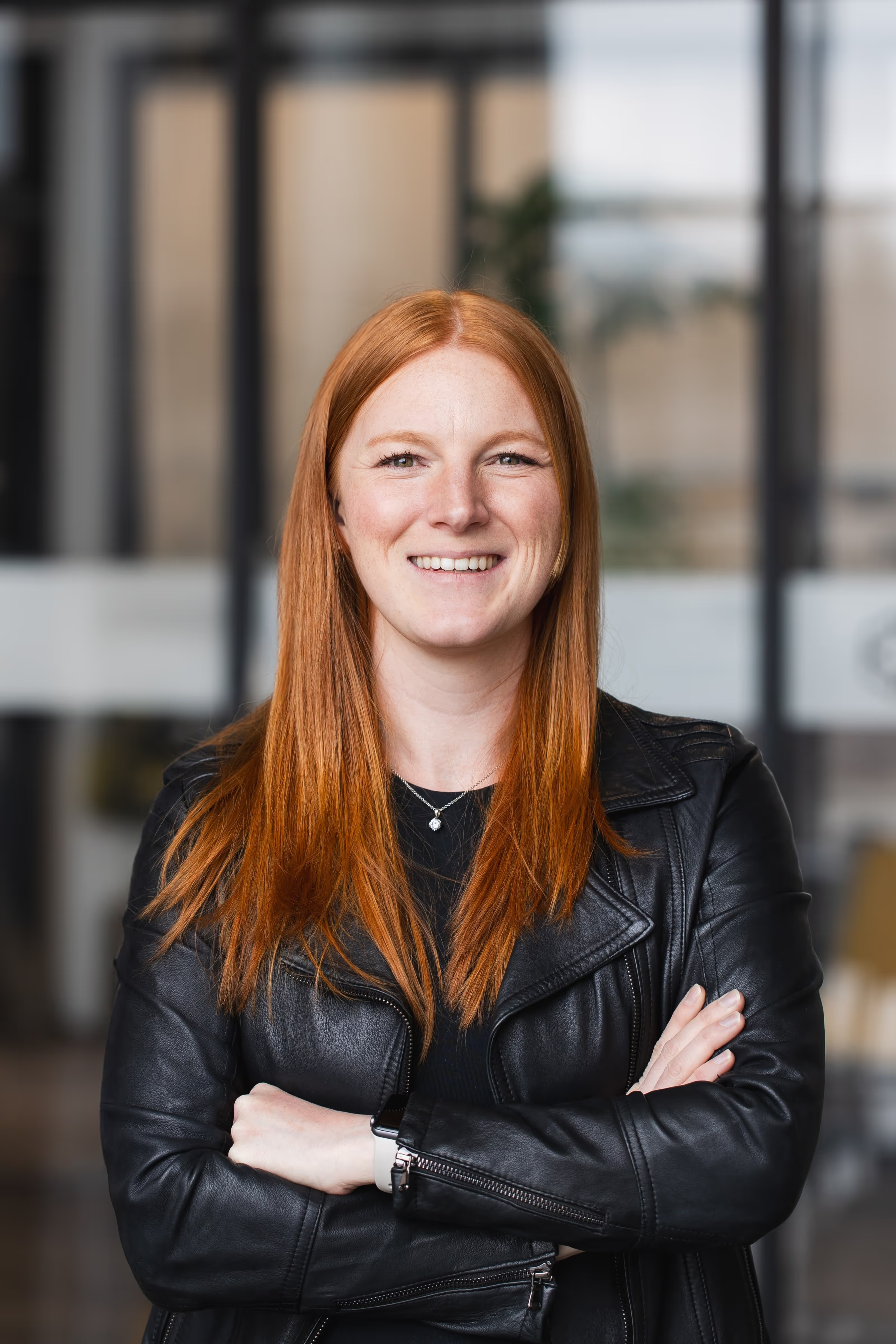

Photo by Rodolfo Gaion
The theme of NorthGuide’s 2025 Global Ecosystem Summit was "Shift Happens." This theme recognized a simple truth: The world we knew is gone. The convergence of generative AI, profound geopolitical realignments, and a fundamental shift in our relationship with work and community have rendered our old playbooks obsolete. The summit gathered builders, investors, and leaders who understood that business as usual is a strategy for obsolescence. We didn't come together to re-hash the problems. We came to build the solutions. A series of candid, powerful conversations coalesced around four critical themes that will guide us in 2026:
The summit was the perfect opportunity for a stark, honest assessment of our ecosystem's ambition. Founders like Stephanie Curcio (NL Patent) and Ali Asaria (Transformer Lab) stated unequivocally that the "business as usual" mindset is failing. This isn't a time for incrementalism. It's a time, as Ali put it, for "emergency mode" driven by tremendous ambition. We were challenged to stop waiting for permission and, as the Socratica team later proved, to simply build. This new mandate for ambition, however, immediately ran into its greatest roadblock: capital.
The AI revolution isn't just creating new companies. It’s fundamentally restructuring how those companies get funded. Salim Teja (Radical Ventures) mapped this new terrain, showing how AI is cleaving investment into three distinct tracks: infrastructure, application and discovery. Each track demands a different capital profile, timeline, and expertise.
This fragmentation is reshaping the entire investment ecosystem. We're seeing traditional boundaries blur—PE firms moving into growth-stage deals, VCs pushing earlier into pre-seed, and corporate venture arms becoming critical partners for market access and validation. George Northcott (Founders Factory) illustrated how strategic corporate partnerships can unlock distribution channels that pure f inancial capital simply can't provide
Brenda Hogan (Venture Ontario) identified the growing importance of "patient capital"—investors willing to take mitigated risks on first-time fund managers and breakthrough technologies that don't fit neatly into traditional return timelines. In a world where some AI applications reach $100M ARR in months while deep-tech ventures require years of development, one-size-fits-all funding models no longer work. The ecosystems that thrive will be those that can deploy the right kind of capital for the right kind of opportunity.
Capital is only half the equation. How and where we build is also fundamentally shifting. Proximity alone isn't enough; we have to intentionally engineer belonging. As Hilary Hartley (Open Public / NorthGuide Board Director) powerfully stated, "belonging is an operational foundation," not a soft perk. It's the psychological safety that underpins high-performing teams.
This theme was brought to life by the next generation of leaders from Socratica, who are building global community on a simple, profound host pledge: If I see someone standing alone in a corner, I will go be their friend. This sentiment was echoed by Amber French (Catalyst Commons), who reinforced that "placemaking" and intentional community design are critical economic infrastructure.
With a new ambition, a new model for capital, and a new understanding of community, the final theme was how we execute. We are all building "Bionic Organizations." Brad Feld framed AI as our "co-pilot," and Millin Gabini (Keyflow) and I shared a session to illustrate this isn't just a new tool—it's a new capability that transforms the organizational chart from a pyramid into an obelisk. This reshaping means individual contributors use AI to act as managers of agents, unlocking massive output
This bionic mandate is the native language of the next generation. The Socratica team isn't waiting for permission. As Nevedhaa Ayyappan explained, stability is not a concept GenZ is familiar with. They value autonomy—the "distance to opportunity"—and "safe spaces for experimentation and failure" over traditional career paths. They’re already building the future, and there’s no slowing it or them down.
The energy, ambition, and shared sense of purpose from the summit cannot dissipate. It's on all of us to take these principles off the page and put them into practice in 2026—in our companies, in our funds, and in our communities. This is our collective call to action. Things have fundamentally shifted. Now it’s time to work differently to ensure these new principles translate into powerful progress.

.avif)


WATERLOO | OTTAWA | NEW YORK
© 2026 NorthGuide. All rights reserved.
NorthGuide® is a registered trademark in Canada and the U.S.
