
Understand that the future, especially with generative AI, won’t be an iteration of the past — it will be fundamentally different. Focus on leveraging these new tools to enhance your capabilities.

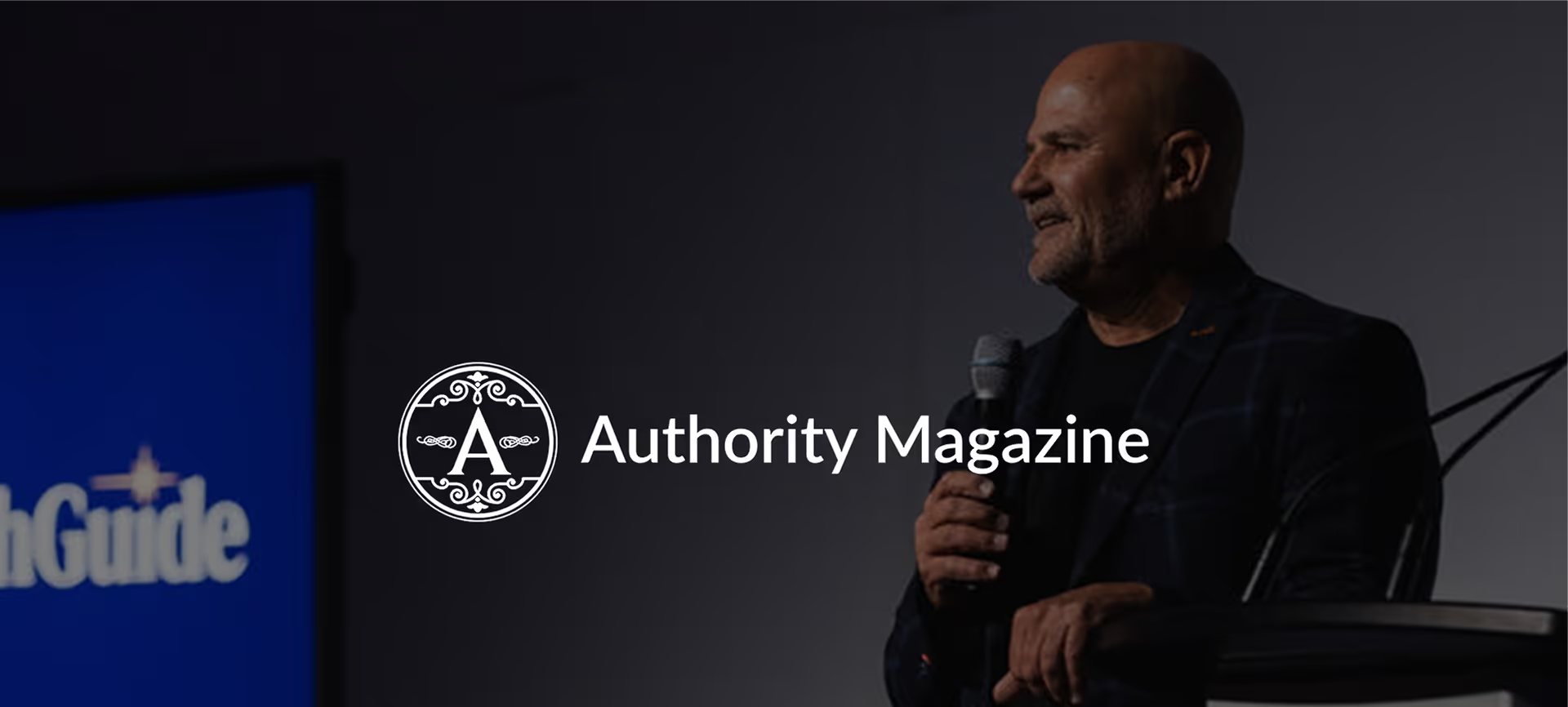
The pace of change is accelerating, with innovations and disruptions reshaping industries faster than ever. Leaders must not only anticipate these changes but also develop strategies to thrive in this evolving landscape. How are forward-thinking leaders preparing for the technologies and challenges of tomorrow? What strategies are they putting in place today to ensure success in the future? As part of this series, we are interviewing Iain Klugman.
Iain Klugman is the CEO of NorthGuide, a strategic company helping to build resilient economies, strong industries, and lasting organizations, and is the former CEO of Communitech Corporation in Canada. During his tenure, he worked with thousands of tech startups and worked with CEOs and directors of many companies including: TD Bank, Thomson Reuters, Manulife, General Motors, Interac, LCBO, WSIB and the Royal Canadian Air Force (RCAF). Previously, Iain was the CEO of Destination Ontario with overall responsibility for the Ontario Brand globally. He was Executive Director of Communications with the Canadian Broadcasting Corporation, and led Global Branding and Advertising for Nortel. Iain has been named one of the 50 most powerful business people in Canada, 50 most influential people in Toronto, and was awarded the Queen’s Diamond Jubilee Medal. Iain has an MPA from Dalhousie University, an MBA from Laurier University, DEP from Rotman School of Management, and AMP from the Wharton School at the University of Pennsylvania.
Thank you so much for joining us in this interview series. Before we dive into our discussion, our readers would love to “get to know you” a bit better. Can you share with us the backstory about what brought you to your specific career path?
My career path wasn’t linear or predetermined. I experimented with different roles and opportunities — some successful, others less so. What remained constant was my desire to do work that had purpose and impact. Finding that alignment between purpose and career took time, but it was worth the journey.
Can you share the most interesting story that happened to you since you started your career?
One of my core principles has been to never take a job I was fully qualified for, because that would mean I’d already done it before. I’ve always looked for ways to bridge my past experiences into new challenges. This approach often left me feeling like an impostor initially, but figuring out how to succeed in these stretch roles has been the most rewarding part of my career journey.
What do you think makes your company stand out? Can you share a story?
What distinguishes our company is our team of exceptional individuals who have come together around a shared purpose. While many organizations claim this, we’ve truly succeeded in assembling a remarkable group of kindred spirits who are aligned not just in our goals, but in our commitment to doing meaningful work with people we respect.
You are a successful business leader. Which three character traits do you think were most instrumental to your success? Can you please share a story or example for each?
Great leaders blend three essential qualities to create real impact:
Empathy transforms how teams work together. When leaders truly understand what drives their people — their challenges, hopes, and goals — it builds the trust that fuels breakthrough performance. Teams innovate more and take smarter risks when they know their leader gets them.
Humility opens the door to honest dialogue and fresh thinking. The best leaders know they don’t have all the answers. This creates an environment where everyone feels valued and ideas flow freely. When leaders show humility, teams feel safe to experiment, learn, and push boundaries.
Strength isn’t about power — it’s about having the courage to make tough calls while staying true to your values. Real strength means knowing when to protect your team and when to challenge them to grow. It’s being the steady hand that guides everyone through both smooth and rough waters.
When these qualities come together, you don’t just manage people — you inspire them to achieve things they never thought possible.
Ok, thank you for that. Let’s now jump to the primary focus of our interview. What emerging technologies do you believe will have the most significant impact on your industry in the next five years, and how are you preparing for them?
The most transformative shift we’re seeing isn’t about any single technology — it’s about how innovation itself is evolving. While AI and quantum computing are making headlines, what’s really exciting is how these technologies are reshaping entire innovation ecosystems.
We’re moving away from the traditional Silicon Valley-centric model to something more distributed and collaborative. Digital technologies have become so accessible that great ideas and successful businesses can emerge anywhere — it’s about how well you can build and leverage relationships across your ecosystem.
AI is really changing the game on this front. Unlike previous waves of innovation that were about disruption, we’re now seeing a shift toward transformation and collaboration. Organizations that succeed aren’t just those with the newest technology — they’re the ones that can effectively combine new capabilities with existing strengths and relationships.
This shift is especially promising for mid-sized regions and organizations. Success today isn’t about competing with giant tech centres — it’s about building on your unique strengths and fostering the right collaborations. We’re seeing regions build specialized innovation ecosystems around their distinct advantages, whether that’s in manufacturing, agriculture, healthcare, or other sectors.
At NorthGuide, we’re helping our clients prepare and navigate this change in several ways:
The key is moving beyond individual technologies to build resilient innovation systems that can evolve and adapt. When we work with clients, we focus on creating lasting value across entire communities, ensuring they’re not just prepared for change — they’re positioned to lead it.
How do you balance the need for rapid innovation with the risk of potential disruptions in your organization?
Successful innovation isn’t choosing between progress and stability — it’s building an approach that delivers both. After working with thousands of organizations, I’ve learned that the most resilient ones don’t chase after every trend. Instead, they take a structured approach to innovation that manages risk while capturing opportunities.
We encourage organizations to think about innovation like a balanced investment portfolio. You want some safe bets (like improving what you already do well), some moderate risks (like expanding into adjacent markets), and a few carefully chosen moonshots that could transform your industry.
This portfolio should be tied to your overall strategic direction. Be clear about where you want to invest in high risk high reward transformative opportunities. This shouldn’t be in every part of the organization. The trick is having a clear process for testing new ideas quickly and governance to decide what’s worth scaling up.
Build innovation into your organization’s DNA in a way that makes you stronger, not more fragile. Success comes from getting better at learning and adapting every day, not from making the biggest splash.
Can you share an example of a strategy you’ve implemented to future-proof your business against upcoming technological changes?
The best way to future-proof isn’t trying to predict every technological shift — it’s building an organization that can adapt quickly and confidently. Let me share a concrete example of how we’re doing this with AI at NorthGuide.
We’ve made AI exploration part of everyone’s job, not just a special project team. Our approach is simple: experiment with AI tools in your daily work, share what you learn, and focus on creating real value for our clients. When someone discovers a way to work smarter or serve clients better, that knowledge spreads quickly across our team.
But we don’t just learn by doing. We regularly bring in experts to work directly with our team on practical applications of emerging technologies. Recently, we had some AI leaders help us enhance our strategic planning and ecosystem analysis work. The result? We’re delivering deeper insights to clients while helping them feel more confident about their own technology adoption journey.
Future-proofing isn’t about having a crystal ball — it’s about building an organization that spots opportunities early and moves on them quickly. You do that by fostering a culture of continuous learning and practical experimentation.
What skills or mindsets do you believe are essential for leaders to thrive in an era of rapid technological advancement?
The most valuable leadership skill today isn’t technical expertise — it’s the ability to see the big picture while staying grounded in practical action. After working with thousands of leaders across different organizations and regions, I’ve noticed that those who thrive share four key qualities:
They’re system thinkers. The best leaders understand that success isn’t just about adopting new technologies — it’s about building the relationships, processes, and culture that help their entire ecosystem grow. They see the connections and opportunities that others might miss.
They’re ecosystem builders. Innovation doesn’t happen in isolation. Great leaders are constantly connecting with peers, researchers, industry groups, and government partners. They know that these relationships help them spot opportunities and find partners who can help turn good ideas into real results.
They’re committed learners. With change happening so quickly, no one can be an expert in everything. Successful leaders know when to bring in expertise, how to ask the right questions, and how to help their teams learn and adapt. They create environments where trying new things is encouraged and learning from setbacks is celebrated.
Most importantly, they put people first. While they stay informed about technology, they understand that lasting success comes from helping people and organizations work together effectively. They’re skilled at building bridges between different groups and helping them collaborate in new ways.

Ok super. Here is the main question of our interview. What are your “Five Things You Need to Prepare For The Disruptive Future”? If you can, please share a story or an example for each.
How do you foster a culture within your team that is both adaptable and resilient in the face of fast-paced innovation?
Building an adaptable team isn’t about having all the answers — it’s about creating an environment where people feel confident exploring new ideas together. At NorthGuide, we’ve developed a straightforward approach that works.
First, we believe that adaptability itself is a form of resilience. Just as hockey players need to skate with their heads up, teams need to stay alert to changes and be ready to adjust course as needed.
We’ve learned that team strength comes from embracing different perspectives. Some team members love trying new things, while others ask the tough questions that help us spot potential risks. When these styles work together, we make better decisions and implement changes more effectively.
Innovation isn’t a sprint, it’s a marathon. Instead of obsessing over day-to-day wins and losses, we focus on our long-term direction. This gives our team the confidence to experiment and learn from setbacks. Not every new approach will succeed immediately, but each attempt teaches us something valuable.
How do you ensure that ethical considerations and social impact remain a priority as you navigate rapid advancements in technology?
At NorthGuide, the “why” behind our work drives everything we do. Every client we partner with is working to create positive change in their communities and regions. So when we think about technology and innovation, we’re always focused on how these tools can help build a better future.
For example, when we help regions develop their innovation strategies, we start by understanding the impact on everyone in the community — not just the obvious players. We create detailed personas representing different groups, from established businesses to emerging entrepreneurs, from urban centers to rural areas. This helps us spot gaps early and create opportunities for all.
Technology is most powerful when it solves real human challenges. When working with AI and other emerging tools, we think through key questions like: Who benefits from this innovation? Who might be left behind? How can we make sure the positive impacts are shared broadly? This isn’t just about avoiding problems — it’s about actively creating solutions that lift entire communities.
This approach isn’t just about doing good — it’s about doing better business. We’ve consistently seen that the most successful initiatives are the ones that consider and benefit their entire ecosystem. When you build with everyone in mind, you create change that lasts.
If you stay focused on making the world better for everyone, ethical considerations become a natural part of how you innovate, not an afterthought. It’s about building future-ready economies and organizations that work for all.
You are a person of great influence. If you could start a movement that would bring the most amount of good to the most amount of people, what would that be? You never know what your idea can trigger. :-)
I would focus on two critical societal challenges. First, addressing the erosion of trust in our institutions — from healthcare and education to government and legal systems. Second, tackling the proliferation of misinformation and fake news. These interrelated issues are fundamental to maintaining a healthy, functioning society.
How can our readers further follow your work online?
LinkedIn — Iain Klugman
LinkedIn — NorthGuide
Website: www.northguide.ca
Thank you for the time you spent sharing these fantastic insights. We wish you only continued success in your great work!
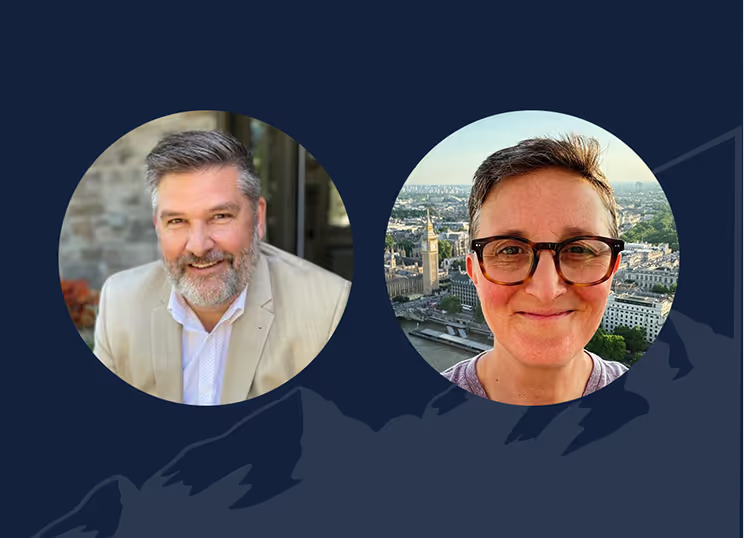
About the Interviewer: Cynthia Corsetti is an esteemed executive coach with over two decades in corporate leadership and 11 years in executive coaching. Author of the upcoming book, “Dark Drivers,” she guides high-performing professionals and Fortune 500 firms to recognize and manage underlying influences affecting their leadership. Beyond individual coaching, Cynthia offers a 6-month executive transition program and partners with organizations to nurture the next wave of leadership excellence.




WATERLOO | OTTAWA | NEW YORK
© 2026 NorthGuide. All rights reserved.
NorthGuide® is a registered trademark in Canada and the U.S.
